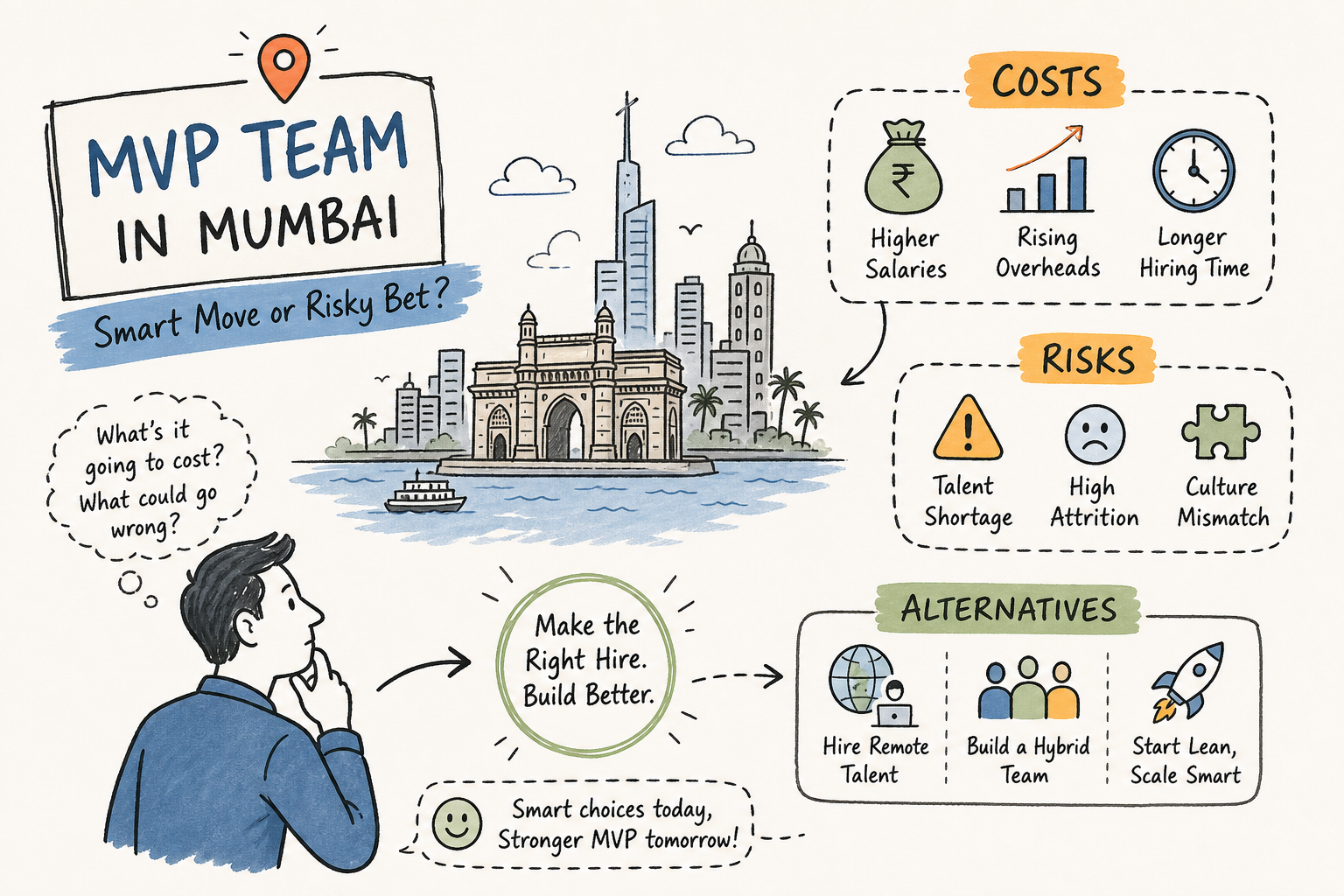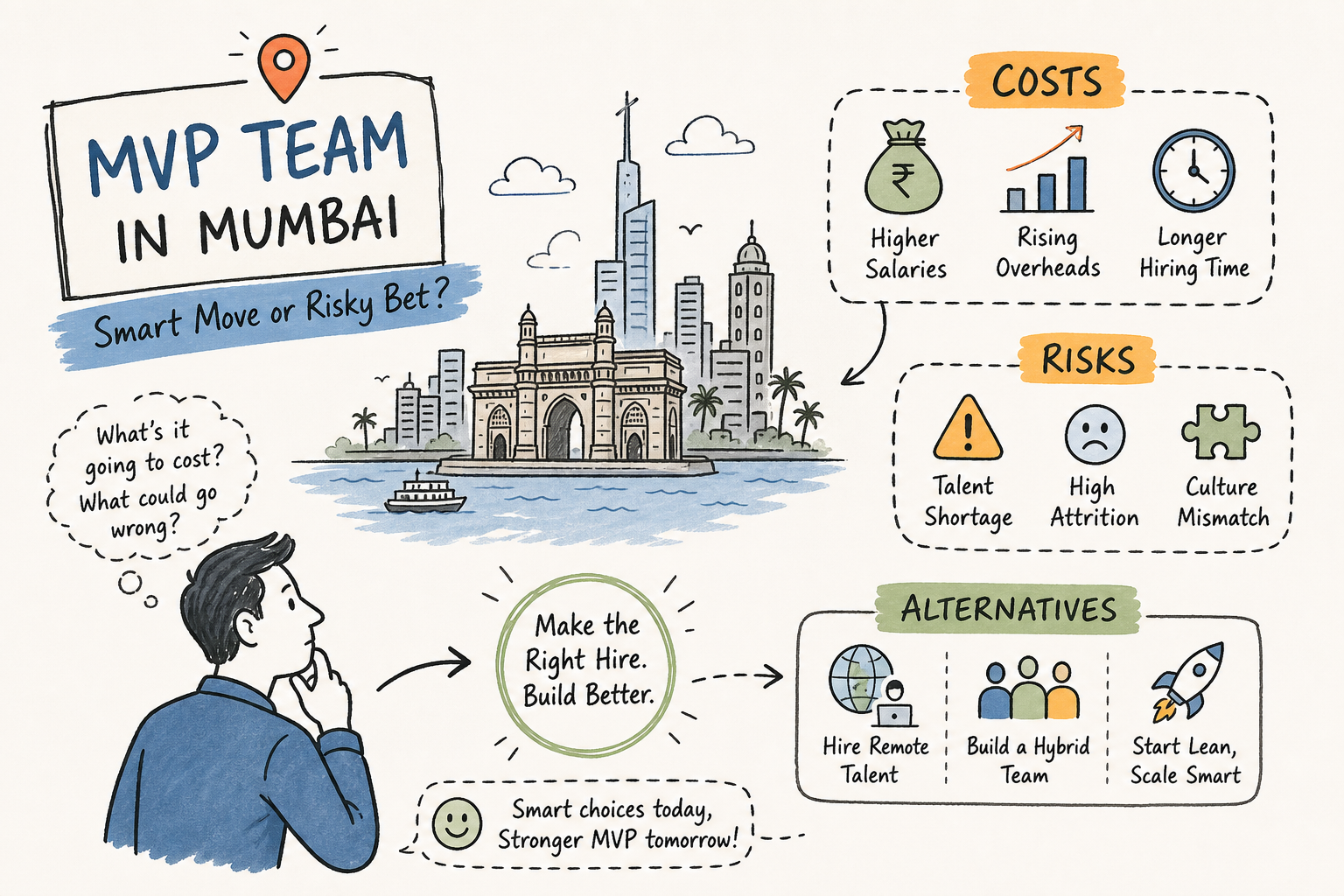
MVP development in Mumbai gives US founders access to a legitimate talent advantage. The city has a dense pool of engineers, competitive pricing, and MVP development companies in Mumbai that have shipped real products for real startups. For a founder on a limited runway, the cost difference between a Mumbai-based agency at $30, 60 per hour and a US agency at $120, 250 per hour is hard to ignore. That math is real, and it deserves to be taken seriously.
But the founders who come to Valnee Solutions after a Mumbai development experience tell a remarkably consistent story: the quote looked clean, the sales conversation went well, and then delivery went sideways. Not because the developers were incompetent, but because the contract lacked protection, the scope drifted, and when things broke down, there was no accountability mechanism to fix it. The gap between what a vendor quotes and what a non-technical founder actually receives is where most deals go wrong.
This is a practical pre-hiring guide covering four areas: cost reality, delivery timelines, IP and legal exposure, and how to separate trustworthy vendors from ones that will burn your runway. Whether you ultimately pursue MVP development in Mumbai or elsewhere, the framework here applies.
What MVP development in Mumbai actually costs
A basic web MVP in Mumbai typically runs between ₹8, 25 lakh, which translates to roughly $10,000, $30,000 depending on vendor type, developer seniority, and design quality. A cross-platform mobile MVP lands in the ₹12, 25 lakh range, while a native iOS and Android build can push to ₹35 lakh or more. At a product agency versus a small studio, the same functional scope can cost significantly more, so the spread in these numbers is real.
What most MVP cost estimates in Mumbai do not include is equally important to understand. Payment gateway integrations, advanced animations, AI features, App Store optimization, ongoing server costs, and post-launch maintenance are routinely excluded from initial quotes. A number that looks clean at signing often hides a second invoice waiting for after kick-off. Before you agree to any estimate, ask the vendor to price these items explicitly rather than assume they are bundled. For more context on common hidden items and how they affect final budgets, see this analysis of MVP development cost factors.
On the vendor type question: a solo freelancer or small studio will quote at the lower end of the range, while a mid-size Mumbai MVP development company adds layers of project management, QA, and design that push cost up but also add accountability. The cheapest option is rarely the safest one for a founder who has no technical background to catch quality issues during the build. Cutting corners on development only to fund a costly rebuild is a pattern that comes up more often than most founders expect.
How long Mumbai-based teams actually take to deliver
For a simple web or utility app, realistic delivery is 2, 6 weeks. A marketplace MVP with buyer and seller flows, payments, chat, and an admin panel typically takes 8, 16 weeks depending on complexity. A SaaS MVP with multi-tenancy, billing, and dashboards runs a minimum of 6, 12 weeks. These ranges assume a clean scope, responsive feedback from the founder, and no major third-party integration surprises. For a detailed breakdown of typical MVP development timelines, consult a timeline reference to set realistic expectations.
In practice, Mumbai-based builds often stretch beyond these benchmarks. The two most common causes are scope additions mid-sprint and slow client approvals that add days to each review cycle. A good vendor enforces a scope lock and a structured user acceptance testing process. If a vendor does not mention scope discipline during the sales conversation, that is a warning sign, especially for a SaaS product where the definition of done is still evolving.
Communication discipline and documentation
One delivery reality worth flagging for any minimum viable product Mumbai engagement: some local teams rely on informal messaging tools for day-to-day coordination, which works for quick questions but creates a documentation gap when decisions need to be traced later. Before work begins, push for a structured project management tool, written sprint plans, and a defined definition of done for each milestone. Informal message threads are not a delivery process.
IP ownership risks and the legal clauses most founders never read
Indian software contracts do not automatically transfer IP to the client the way US contracts typically do. Without an explicit work-for-hire or IP assignment clause, the agency may retain rights to the codebase after delivery. The safest contracts use present-tense assignment language: "Developer hereby assigns to Client all rights, title, and interest..." rather than the weaker "Developer agrees to assign," which leaves room for dispute. Verify this clause is in your contract before you sign anything. Learn more about the core IP clause language to watch for when negotiating assignments.
Access rights and credential control
A second ownership risk is access, not just legal title. Some MVP agencies in Mumbai retain admin control of the GitHub repository, cloud hosting account, or third-party service credentials during the build and do not transfer that access cleanly at handoff. Confirm in writing that you hold admin access to all repositories, cloud environments, and analytics accounts from day one, not only at project close. A vendor who resists this is a structural red flag, consider requesting milestone-based access transfers and post-termination handover obligations written into the contract.
Third-party licensing compliance
Licensing compliance is another exposure most founders overlook. If a vendor builds using unlicensed third-party components or improperly integrated open-source libraries, that can expose you as the product owner to significant legal risk. A solid contract includes a clause requiring the vendor to document all third-party dependencies and confirm that their usage complies with the relevant licenses. This is not excessive. It is standard due diligence for any production-ready MVP.
How to vet a Mumbai MVP development company before committing
The interview questions that separate serious vendors from salespeople are centered on process, not portfolio. Ask every vendor how they define an MVP scope from a vague idea, what they typically cut from version one, and what their QA process looks like before release. A vendor who jumps to solution mode without asking about your validation assumptions is not a product partner. They are a feature factory, and on a limited runway, that distinction is expensive.
On pricing structure: fixed-price contracts offer budget predictability but require a locked scope. Time-and-materials contracts are flexible but can drift. For prototype development in Mumbai, a phased engagement starting with a paid discovery sprint is the lowest-risk entry point. It lets you assess the team's product thinking and communication quality before committing to the full build. Any vendor unwilling to offer a scoped discovery phase before a full contract deserves extra scrutiny.
Use a simple scorecard when you shortlist agencies. Rate each one on these criteria:
- Discovery quality and ability to challenge unnecessary scope
- Relevant MVP case studies with named clients and measurable outcomes
- Code ownership transparency and contract language
- Delivery process maturity, including sprint structure and UAT discipline
- Communication quality and named point of contact
- Post-launch support terms
Agencies that score high on delivery but low on validation mindset and scope discipline are a specific risk for MVP work. The product you build in the first sprint shapes everything that follows.
The real cost of the time zone gap and accountability gap
Mumbai operates at IST, which runs approximately 9.5, 10.5 hours ahead of US Eastern time depending on daylight saving. In practice, there is often a 2, 4 hour overlap window between your working day and a Mumbai team's morning, depending on how both sides structure their schedules. Questions that surface in your afternoon wait until the next morning. On a fast-moving MVP build, a 24-hour feedback loop on a single design decision accumulates into real timeline slippage over a 10-week project. Managing that gap requires active coordination that most non-technical founders are not positioned to provide without support. Best practices for overcoming time zone challenges in offshore development can reduce friction and preserve momentum.
When something goes wrong mid-build, the accountability gap in offshore development is not hypothetical. Many standard vendor contracts lack strong penalty or escrow mechanisms when a milestone is missed. The vendor holds the code, the timeline, and the communication channel. Founders in this position typically have three options: push harder, pay more for expedited work, or start over. None of those outcomes protect your runway. The question to ask every vendor before signing is: what happens contractually if you miss a committed deadline? If there is no clear answer, there is no real accountability.
Cross-border enforcement between a US founder and an Indian agency can be more difficult and costly than domestic remedies, which is precisely why you should build accountability into the contract rather than rely on post-dispute resolution. Build in milestone-based payment terms, a defined handoff process, and explicit ownership transfer language at each phase. A well-structured contract is your primary protection, not the legal system.
What a better model looks like for US founders doing MVP development in Mumbai
Valnee Solutions was built specifically for this problem, bringing together the cost discipline of a focused development partner with the accountability structures that offshore arrangements operating on good faith typically lack. Valnee states that it operates on a fixed-price model with a guaranteed launch date written into the contract, and that if a deadline is missed, billing stops and development continues at no cost until the milestone is delivered. Founders evaluating this model should request a copy of the standard contract terms and client references to verify these commitments directly.
Every concern raised in this guide maps to how Valnee structures a project. The company states that code ownership transfers fully to the client from day one, that milestone tracking is real-time and visible, that discovery is a formal phase rather than a sales call, and that post-launch support and roadmap planning are included in the engagement rather than quoted separately after launch. For a non-technical founder who cannot manage an offshore vendor across a 10-plus-hour time difference, a partner with contractual accountability built in represents a fundamentally different kind of engagement than a development vendor operating on trust alone.
Making the right call before you sign
MVP development in Mumbai offers real cost advantages, and the talent pool is genuine. But the gap between a good outcome and a burned runway almost always comes down to the same factors: a contract with explicit ownership terms, a vendor with a disciplined delivery process, a communication structure that does not create a 24-hour feedback lag on every decision, and milestone-based payment terms that keep the vendor accountable throughout the build.
The checklist in this article gives you a framework to evaluate any MVP development services Mumbai providers or vendors elsewhere. Demand a paid discovery phase before committing to a full build. Lock the scope in writing before a single line of code is written. Confirm who owns what, including repositories, cloud accounts, and design assets, before the project starts.
If you are a non-technical founder who needs a predictable outcome on a fixed budget, the model matters as much as the market. Start with Valnee Solutions if you want those accountability terms built into the contract from the start, and ask to see the contract before you commit. Or use the framework here to run your own evaluation. Either way, do not sign until you have clear answers to the ownership, timeline, and change-order questions this guide raises.

 Valnee